|
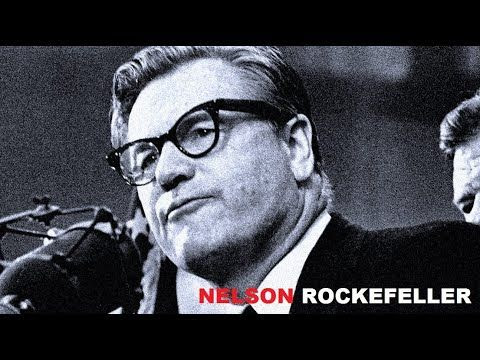
| Source:POLITICO- Governor Nelson Rockefeller (Republican, New York) announcing his 1968 presidential campaign. |
"Nelson Rockefeller, governor of New York and future vice president under Gerald Ford, is not a patient man. For the most powerful member of the most powerful family in the most powerful nation on Earth, time is a commodity, like wealth, women, art and talent, to be experienced on his terms. “Nelson is like a polar bear,” says George Hinman, the governor’s courtly emissary to the Republican National Committee. “You shoot at him, and he just keeps coming on.”
Tonight, however, is different. On this second night of the 1964 Republican convention, a slot reserved for debate over the party platform, even Rockefeller is a clock-watcher. Although outnumbered and outmaneuvered by conservative forces supporting Arizona Sen. Barry Goldwater for president, Rockefeller has come to San Francisco to register a very public protest of the direction his party is taking.
Convention organizers are just as determined to smother dissent in tedium. By shoving tonight’s duel over the platform past the 11 p.m. prime-time window on the East Coast, the governor’s enemies can figuratively achieve what Goldwater had once proposed literally—to saw off the eastern seaboard and let it float out to sea. This was no mere figure of speech. In the closing days of the deadlocked 1960 campaign between John Kennedy and Richard Nixon, the Arizonan had offered GOP convention chairman and Kentucky Senator Thruston B. Morton some characteristically pungent advice. Forget the urban East, said Goldwater; Nixon should concentrate his remaining efforts in Illinois and Texas. “I’d like to win this goddamned election without New York,” Goldwater rasped. “Then we could tell New York to kiss our ass and we could really start a conservative party.”
Barely eight years have elapsed since Republicans assembled in this same city to re-nominate Dwight Eisenhower for a second term. Ike’s mantra of Modern Republicanism accepted much of the welfare state improvised by Democratic President Franklin D. Roosevelt, while casting off the isolationist dogma of hard-shell conservatives led by Sen. Robert Taft. To Goldwater, the Eisenhower years represent “a dime-store New Deal.” The senator has suggested making Social Security voluntary, repealing the graduated income tax and suspending American financial support of the United Nations should the world body admit Communist China. Goldwater frowns upon foreign aid, farm subsidies and federal assistance to education. He tells Newsweek that as president he won’t hesitate to drop a low-level atomic bomb on Chinese supply lines in North Vietnam or “maybe shell ’em with the Seventh Fleet.” With equal pugnacity, he would direct Fidel Castro to turn on the water supplying the American base at Guantánamo, “or we’re going to send a detachment of marines to turn it on and keep it on.”
His followers are populists in pinstripes, middle-class revolutionaries who mirror the migration of talent and industry from the moneyed East to the burgeoning Sun Belt. To Atlanta Constitution editor Eugene Patterson, the Goldwater legions are “a federation of the fed up,” as dismayed by the moral laxity of liberal America as the greed of the tax collector and the erosion of yesterday’s individualistic, aspirational culture by social engineers and legislators masquerading as judges. Outside the candidate’s suite at the Mark Hopkins, one proverbial little old lady in tennis shoes is gently turned away, but not before trilling, “I just wanted to tell Senator Goldwater to be sure and impeach [Chief Justice] Earl Warren.”
A decade after the Warren Court banned racial segregation in the nation’s schools, this is carrying coals to Newcastle. Two weeks ago, Republicans on Capitol Hill provided the margin of victory for the 1964 Civil Rights Act outlawing discrimination in public accommodations. Goldwater cast one of six GOP votes against the landmark legislation. Anything but a racist, in the 1940s the senator had taken the lead in desegregating his family’s department store, as well as the Arizona National Guard. Yet his brand of rugged individualism recoils from anything that smacks of federal coercion at the expense of local sovereignty.
Rockefeller hails from a very different tradition. The struggle for racial equality is as much a part of his family lineage as oil wells and art museums. In the 19th century, his grandfather, otherwise stigmatized as the prototypical robber baron, had endowed Atlanta’s Spelman College to educate black women. Nelson’s father, John D. Rockefeller Jr., supported the Urban League and United Negro College Fund. As an adolescent, Nelson paid the tuition of a youngster attending Virginia’s historically black Hampton Institute. When the Rev. Martin Luther King Jr., hero of the Montgomery bus boycott, was stabbed by a crazed assailant during a 1958 visit to Harlem, the preacher’s medical bills were quietly paid by Nelson Rockefeller. More recently, Rockefeller has helped rebuild black churches burned to the ground by Southern bigots and furtively supplied bail money to sustain Dr. King and his Children’s Crusade against the rigidly segregated power structure of Birmingham, Alabama. Rockefeller’s New York state government has banned racial discrimination in the sale or rental of apartments, commercial space and private housing developments.
On hearing it said that Goldwater is in the mainstream of their party, Nelson replies acidly that it must be a meandering stream indeed. In any event, it flows to the right if the party platform is any indication. Written to Goldwater’s specifications, the document nods dutifully in the direction of “full implementation” of the new civil rights law, though avoiding the politically charged word “enforcement.” Instead, the party credo denounces what it calls “federally sponsored reverse discrimination,” language seen by Goldwater’s opponents as a crude appeal to resentful whites, whose existence in the millions is confirmed by a casual glance at the day’s newspapers. The New York Times reports that the owner of the Hotel Martha Scott in Opelika, Alabama, is closing his establishment rather than “bow to tyranny” by admitting blacks. A few days ago, three black youths attending a Fourth of July rally at the Atlanta fairgrounds were beaten with metal chairs.
At the White House, meanwhile, President Lyndon Johnson is assigning 50 FBI agents to lawless Mississippi, where Northern civil rights workers have been murdered and white-sheeted Klansmen roam at will. White backlash is by no means restricted to the South. Goldwater backers read into the recent strong showing of Alabama’s segregationist Gov. George Wallace in Northern Democratic primaries the stirrings of a political realignment that will dissolve at last the old New Deal coalition that for 30 years has dominated American politics. It is a prospect that holds little appeal for Rockefeller Republicans.
When convention chairman Morton repairs to a nearby trailer command post to quench his thirst, his place behind the podium is taken by Oregon Gov. Mark Hatfield. Less than 24 hours ago, Hatfield made history as the first keynote speaker ever to be booed by his own party’s delegates. His offense? Lumping the right-wing John Birch Society—whose leader Robert Welch Jr., had linked Dwight Eisenhower and John Foster Dulles to the international communist conspiracy—with the Ku Klux Klan and the Communist Party USA in a denunciation of political extremism.
It is on the extremist issue that Rockefeller has chosen to make his stand, just as soon as those dictating the convention schedule allow him five minutes to address the nation. Asked over the years why he hasn’t simply changed his party registration, something first urged on him by FDR, Rockefeller replies that he would much rather be pushing the GOP elephant forward than holding the Democratic donkey back. Until now, the governor’s need to woo conservatives in the hinterlands has acted as a brake on his free-spending instincts, producing a “pay as you go” liberalism that supplants racially charged talk of states’ rights with a muscular federalism grounded in states’ responsibilities. Fiscal prudence and social conscience: These are the building blocks of Rockefeller Republicanism. To many on the right, the term is an oxymoron. Already they detect in the governor’s creative use of state bonding authority the seed corn of future bankruptcy. They argue that there is no gauging the financial consequences of Rockefeller-style activism untethered to ideology.
It is a few minutes after nine o’clock, midnight in the east, when Rockefeller bounds up to the platform. “They were throwing paper at him,” Joe Boyd, a loyal Rockefeller aide, remembers. An angry Boyd hands Rockefeller’s speech to the governor’s one-man security detail and charges off into the stands. Grabbing one of the ringleaders, the diminutive Boyd lifts him out of his seat. “OK, who’s next?” he shouts. An uneasy quiet is restored.
On the platform, an even nastier confrontation is only narrowly averted as convention Chairman Thruston B. Morton, professing concern for Rockefeller’s safety, urges him to postpone his remarks. To drive his point home, Morton resorts to a little body language.
“You try to push me again,” snaps Rockefeller, “and I’ll deck you right in front of this whole audience.”
His introduction elicits a thin chorus of cheers from the New York delegation, quickly lost in a swelling chant of “We Want Barry.” A tight smile, not extending to his slitted eyes, creases Rockefeller’s handsome face. Impassively, he scans the seething hall until his glance comes to rest upon his wife, occupying a box high above the delegates. Less than six weeks after giving birth to their first child, Happy Rockefeller wears a stricken look.
The new Republican majority is in no mood to be lectured by Nelson Rockefeller. Having cooked his own goose, conservatives reason, Rockefeller is now serving it up stuffed with sour grapes. “Remember he was waging war on a platform they had written,” explains Doug Bailey, then a Rockefeller policy researcher. “They were absolutely convinced that the only reason he was doing what he was doing was to hurt Barry Goldwater in the general election. They knew that. They knew that to the marrow of their bones.”
Taking advantage of a lull in the derisive chorus, Rockefeller begins speaking. “During this past year I have crisscrossed this nation fighting to keep the Republican Party the party of all the people and warning of the extremist threat—” Outraged voices interrupt him. Below and to the left of the podium, Californians in bright orange Mae West jackets jeer their nemesis. Their catcalls are taken up by red-faced Republicans from Texas, Ohio and Washington State. As the decibel count rises, Morton spreads his hands helplessly. The governor should be allowed to speak his piece, the chairman says. “It’s only fair and right.”
The hall begs to differ. Rockefeller’s mention of a speech he’d planned to give at Loyola and its “cancellation by coercion” days before the crucial California primary—a blatant public condemnation of the divorced and remarried governor by the Catholic hierarchy—drives a tall blonde woman on the floor over the edge. “You lousy lover,” she shrieks, “You lousy lover.” A youthful Goldwater runner chimes in “You goddamned Socialist,” before adding, less than eight months since John Kennedy’s assassination, “I wish somebody would get that fink. Maybe it would save this country.”
Rockefeller isn’t going anywhere. He doesn’t control the audience, he reminds Morton. It’s up to the chair to impose order. Only then, he mutters into the live microphone, can he finish what he came here to say. A Louisiana alternate delegate points to the explosive galleries and directs his neighbor, “Look at that. It’s America up there.” Glancing around him, Bailey, the policy researcher, observes a deputy of the San Mateo County Police booing Rockefeller. “I looked down at his arm, he has a pistol in an unsheathed holster, and I decided from that point I couldn’t dare take my eyes off that guy, because I had no idea what he was going to do,” recalls Bailey. His colleague John Deardourff is reminded of a German Bund meeting in the 1930s.
Strangely subdued in the pitching sea of noise is Alabama’s solid-for-Goldwater delegation. Their eyes are all on a tall, athletic black man standing in a nearby aisle and shouting, “That’s right, Rocky. Hit ‘em where they live.” Jackie Robinson is a Rockefeller Republican, a baseball legend and a hero to millions of Americans. At one point a ’bama delegate, enraged by Robinson’s chant, leaps to his feet. He is about to commit physical assault on the star athlete until he is restrained by his wife.
“Turn him loose, lady, turn him loose,” bellows Robinson.
At the podium Rockefeller is openly taunting the crowd. “This is still a free country, ladies and gentlemen,” he declares. Here is the incident that Goldwater’s opponents have tried all week to provoke. It comes far too late to prevent the senator’s nomination. But it pins the extremist label on Goldwater and his movement more effectively than Lyndon Johnson ever could. As the minutes crawl by the Cow Palace becomes a political slaughterhouse, wherein any prospects for Republican victory in November are rapidly expiring before a stunned television audience.
Behind the lectern Rockefeller nervously taps his foot like a bull pawing the ground. You don’t have to nominate me is the unspoken message delivered to the bull-baiters. But you’re going to have to listen to me. It is one of those rare moments in history when a page is visibly being turned, a past noisily discarded. The drama of personal confrontation obscures much of what Barry Goldwater’s party is rejecting: the polarizing governor of New York, to be sure, and with him the presumption of regional superiority, the stranglehold of eastern money and the liberal consensus which, for most of the 20th century, has offended fundamentalists of various schools. In politics as in art, it is Rockefeller’s fate to be surrounded by primitives.
The booing escalates as he decries “anonymous midnight and early morning phone calls. That’s right.” A fresh wave of anger swamps the podium, as Rockefeller lashes out at “smear and hate literature, strong-arm tactics, bomb threats and bombings. Infiltration and takeover of established political organizations by Communist and Nazi methods!” His Aldrich jaw protruding like a ship’s prow, Rockefeller half shouts into the din, “Some of you don’t like to hear it, ladies and gentlemen, but it’s the truth.” More boos. Renewed cries of “We Want Barry.” At the lectern a glowering Morton wields his gavel as a weapon. “I’m going to finish this last line,” Rockefeller insists. “I move the adoption of this resolution.”
At last, with a flippant wave, Rockefeller turns to go, appearing “for all the world like he had been given a standing ovation,” marvels Governor Hatfield. “He couldn’t have had a happier look on his face.”
The next morning, hours after all three moderate motions went down in flames, Rockefeller ran into his communications director Hugh Morrow. “You look like the wrath of God,” he told Morrow, who blamed his appearance on the previous night’s fiasco, described by the New York Times as “Bastille Day in Reverse,” and his subsequent quest for alcoholic oblivion.
“I had the time of my life,” said Rockefeller.
This same bleak Wednesday, Pennsylvania Gov. Bill Scranton telephones former President Eisenhower, still a powerful party figure, to inform him of plans to withdraw from the race (something Ike has been urging on him for days). Out of the question, says Rockefeller, when he hears about the call. If Scranton gets out, then Rockefeller will get back in. Someone has to carry the moderate banner. Too much is at stake to allow their actions to be governed by bruised feelings, bogus appeals to party unity or the specter of public humiliation. His pep talk convinces the patrician governor of Pennsylvania, mocked by detractors as the Hamlet of Harrisburg, to let the drama play itself out. And it illustrates the central paradox of Nelson Rockefeller, who is never more appealing than when fighting for his life, even if it is his own conduct that places him in that precarious condition.
Though denounced as a party wrecker, he refused to switch political allegiances, even for the presidency. An emotionally guarded extrovert happiest in the world of artistic contemplation; a scion of the American Establishment who was most comfortable playing the renegade: All his life Rockefeller went against the grain.
"Governor Nelson Rockefeller's 1964 Republican Convention Speech. Grandson of billionaire John D. Rockefeller, Nelson Rockefeller's 1964 Republican Convention Speech."
To understand Nelson Rockefeller's politics, you have to first understand the 1964 Republican National Convention, in hippie, left-wing San Francisco (of all places) and where the Republican was pre-Barry Goldwater under Dwight Eisenhower and Richard Nixon. Because the pre-Goldwater Republican Party, was Nelson Rockefeller's party. The post Rockefeller/Eisenhower Republican Party, is a classical conservative (if you don't like libertarian) political party. Both center-right parties, but fairly different.
I know this going to sound like an Oxymoron to anyone whose not a political history junkie, such as myself or Richard Norton Smith, but the Republican Party really up till the 1990s, had a strong, center-right Progressive Republican faction in it. And, no, I'm not talking about left-wing, antiestablishment, hipster, revolutionaries, who want to take over the American Government and replace it with some type of socialist state, which is how Progressives tend to get stereotyped today.
During the Eisenhower/Rockefeller and even Richard Nixon era, in late the 1960s and early 1970s, there were center-right, Progressive Republicans. People who tended to agree with Conservatives on foreign policy and national security, law enforcement, the U.S. Constitution, individual freedom and personal responsibility.
But these Progressive Republicans also believed in civil rights, a commonsense regulatory state, equal rights, equal justice, and a public safety net for people who truly needed it, and infrastructure investment. Newt Gingrich up until the time he dropped out of the presidential race in 2012, was a Progressive Republican and perhaps still is.
So, in 1964, when then Governor Nelson Rockefeller, knew that he didn't have the votes at the Republican National Convention to be their nominee for President, took a stand at that convention and laid into that party about where they were going and where thought the Republican Party should still be at that point. And the Goldwater delegates booed the hell out of him, but they didn't stop him from getting his point across.