Showing posts with label Crash Course. Show all posts

Tuesday, June 4, 2019

Crash Course: Craig Benzine- 'Freedom of Speech: Government and Politics'

Source:Crash Course- Thanks to our First Amendment: thank our Founding Liberals.
"Today, FINALLY, Craig is going to talk about Free Speech! Now, free speech is so important because it not only allows you to critique the government, but it also protects you from the government. But it's essential to remember that not ALL speech is protected equally under the First Amendment, and just because you have a right to free speech doesn't mean your employer, for instance, can't fire you for something you say (unless your work for the government and then things get a bit more complicated). So we'll take a look at a couple significant Supreme Court cases that have gotten us to our current definition of free speech, and we'll also discuss some of the more controversial aspects of free speech - like hate speech."

Source:Crash Course

From Wikipedia

"The First Amendment (Amendment I) to the United States Constitution prevents the government from making laws which respect an establishment of religion, prohibit the free exercise of religion, or abridge the freedom of speech, the freedom of the press, the right to peaceably assemble, or the right to petition the government for redress of grievances. It was adopted on December 15, 1791, as one of the ten amendments that constitute the Bill of Rights."

When it comes to the U.S. Constitution and the amendments to it and our Bill of Rights, I'm not an absolutist on anything, but neither is the U.S. Constitution and our Founding Fathers. ( Our Founding Liberals ) We have a right to self-defense in America which even includes firearms, but we don't have a right to open fire and fire randomly at people at a church, or restaurant, or some other public place where a lot of people could be there.

When it comes to the First Amendment: we have a right to believe whatever we want too and for the most part even have the right to say whatever we want to, but we can't order for someone to be beat up or killed. We can believe in and practice any religion that we want, or no religion at all, but we can't kill or physically attack other people or places in the same of our religion.

When it comes to free speech, I'm not an absolutist, but as a Liberal who of course believes in liberal democracy I guess you can call me a fundamentalist. ( And this is coming from an Agnostic ) It's not the job of government or anyone else really to tell people what they can believe and how they should think. It's the job of government and ourselves as individuals to protect our physical safety and economic security, but not our feelings.

Liberal democracy, is not easy and you really have to want it to be able to live with it, because it comes with a lot of rights and responsibilities. You have the ability to say whatever you want and believe in it ( short of inciting violence, falsely accusing people, or false advertising ) but so does everyone else including people you don't like, tend to disagree with, or even hate what they have to say. But then you have to the First Amendment right to make the case for why the people you disagree with are simply wrong and then they can respond to you. And maybe you can have a great debate about what you believe and why you oppose what you oppose.

That's called liberal democracy, free speech, and just one thing that  has always made America great and exceptional. And as long as we stand by and up for our liberal democratic values like free speech, no one will ever have to try to make America great again, because we'll always be great and exceptional. 

You can also see this post on WordPress.

Thursday, November 23, 2017

Crash Course: John Green- 1984 by George Orwell- Crash Course Literature

Source: Crash Course-
Source:The Daily Review

Under George Orwell, 1984 is a dystopia where everything is in black and white and apparently rainbows don't exist. You can have black or white, water or skim milk, thats it and no other choices. A very depressing state where it's always dark with no light not even street lights or ever flashlights. Sounds like a world for only chronic depressives and bedwetting leftists who are only happy when they're sad. Up is down, water is dry, rocks are soft, fire is cold, ice is hot, Catholics are Muslim, facts don't even exist, let alone matter. Sort of sounds like Donald Trump's head and state of mind. I was going to leave any Trump jokes and personal jokes out of this on Thanksgiving, but I changed my mind.

Part of Orwell 1984 is about big government, big brother, even though George Orwell was a Socialist and at least shared the goals of Democratic Socialists, but didn't like communism. But he envisioned where everyone basically lived in a complete police state where Big Government always knew what everyone was doing and even talking to. See, in a communist state or a theocratic fascist state, there's no such thing as privacy even, let alone a right to privacy and everyone is subjected to the police state where freedom and individualism are not allowed or even exist.

Imagine doing time in a prison that is the size of a major country. Take North Korea, just to use as an example and you'll know what a police state is like. One gigantic national prison where everyone in society is doing hard time. Talk about raising your kids in prison and if watch those famous prison shows on cable, you'll know what I mean because they cover inmates who also have kids and women who've actually given birth in prison.

Orwell 1984 sounds like a great book for people who've swallowed jars of happy pills. Perhaps mistaking them from sleeping pills in an  attempt to commit suicide and now have just shot themselves in the foot twice. They go from being chronically depressed to being too happy and never being able to go to bed because they're so excited all the time about how awesome life is now for them and are given 1984 by a friend which brings them back down to earth from the Planet Galaxy or wherever. And now they're back in the state of mind where they were before about how much life sucks. If I'm ever too happy which as a realist that will be one hell of a goal to try to accomplish, like trying to swim across the Atlantic Ocean with one arm and one leg, I might actually read Orwell 1984 at some point. Or just move to North Korea to see what life is like in a police state.
Crash Course: John Green- 1984 By George Orwell: Crash Course Literature

Thursday, August 3, 2017

Crash Course: Craig Benzine- 'The Golden Age of Hollywood: Film History'

Source:Crash Course- from Craig Benzine.
Source:The Daily Review 

"It's time for the glitz and the glamour of big motion pictures that helped keep American spirits up during and after the Great Depression. Sound was a huge change to motion pictures, but there were still a few technological innovations to come, like color and aspect ration. Today, Craig walks us through the Golden Age of Hollywood." 

From Crash Course

Damn, if Craig Benzine could only talk faster and not have to take breaths in-between words, he could get a lot done. But seriously, this guy must have a year supply of free Red Bull or Starbucks coffee, because he makes speed freaks sound like comatose patients. I'm not saying I've never heard someone else talk faster and for a longer period of time, I just can't name anyone right now. I would have to go through all of my memory banks and cash all them out and I might not be able to come up with another time where I heard a faster, longer talker.

I'm not going to cover much of what Craig Benzine said there, because I don't have slow-mo on my computer and he just went through all of these areas really fast. But the Golden Age of Hollywood really for me goes from the 1940s up until the 1970s or so. It was an era where movies were about writing, plot, directing, and acting. Not who swears the most and loudest and who is the biggest asshole in the movie. Catch phrases that make rookie no names actors stars overnight where everyone in country is using that catch phrase to describe whatever current situation they're facing.

To succeed in the Golden Age of Hollywood, you really had to be able to write to make it as a writer. Unlike today where phrases and words are borrowed from other shows and movies and used for their shows and movies. The Golden Age of Hollywood wasn't cookie-cutter, but originalist.

Movies like Mr. Smith Goes to Washington from 1939 with Jimmy Stewart and many others. You can't really say there was a move like that before and there have been many attempts to make another great political movie and movie about Congress since, but most of them have come up weigh short. Mr. Smith came out in 1939 and almost either years later it's still one of the best and most popular movies in Hollywood history.

North by Northwest- still my all-time favorite movie and I would argue at least is Alfred Hitchcock's best movie, even though many others would argue for Notorious instead. There really isn't another movie like North by Northwest. Yes it's a Cold War movie involving the CIA trying to catch a traitor they believe is selling U.S. Government secrets to Russia and perhaps other communist states. So that by itself doesn't make it original. But you have a movie where ordinary people become heroes. Again that doesn't make it original, but it's how it was done.

The closing action scene where the good guys defeat the bad guys takes place on Mount Rushmore in South Dakota. Can't believe someone other than Alfred Hitchcock would come up with that. And then you have Cary Grant as the lead actor who arguably is the most handsome actor of all-time, but he also happens to be the best actor and also one of the funniest actors with incredible comedic timing. James Mason very similar to Cary Grant as far as what he brought to his parts, as the lead bad guy. Martin Landau playing a supporting role. The beautiful and adorable Eva Marie Saint who was also a great actress, as the lead actress.

 It wasn't a suspense movie. It wasn't a thriller. It wasn't an action movie. It wasn't a mystery. It wasn't a comedy. North by Northwest was all of those things in an action-packed movie with a lot of humor in it. That again was sell well-written, directed and delivered. Where the actors and crew knew they were part of something really special and wanted to be there and do their best work.

Today where in an era of Hollywood where TV and movies are about style and appearance. Who is up and who is down, who looks and sounds the hippest and has the most pop culture and reality TV appeal. Instead of who can actually act, who can improvise and be themselves and come off as likable and as someone who not only knows what they're doing, but can bring something different in value that perhaps hasn't been seen before. Where the biggest jerk (to put it mildly) who not only swears the most and puts people down as the most tends to be the most popular. Even if they're no better than your average reality TV star as far as their ability to act.

Today if the public likes the performer and they're so-called viral on social media and the internet, they'll continue to work and make a good living in Hollywood. Even if all their shows and movies are garbage as far as the material. Their shows and movies will continue to sell even if the critics are beating the hell out of their performances and not taking those performers seriously, let alone respecting their work.

The Classic Hollywood era was anti-reality TV. Of course they loved their beautiful, sexy, and adorable actresses. Women like Sophia Loren, Marilyn Monroe, Ava Gardner, Lana Turner, Elizabeth Taylor, Joan Collins, and many others were all big stars back then. And Hollywood loved their big handsome studs. Actors like Rock Hudson, Cary Grant, Dean Martin, Sydney Poitier, and many others. But the difference being that the Hollywood goddess's and gods, were more than their beautiful faces and bodies.

If you couldn't act back then, if you didn't show up for work, then you didn't work. It wasn't an era where Hollywood was trying to sell personality and popularity when it came to their characters, over substance. Classic Hollywood was a professional era where the professionals were in charge which is what makes it so great and classic. As long as reality TV is dominating TV and movies, we won't see another great era in Hollywood again. 

Friday, March 4, 2016

Crash Course: Craig Benzine- 'Federalism: Crash Course Government and Politics'


Source:Crash Course- American federalism.

"In which Craig Benzine teaches you about federalism, or the idea that in the United States, power is divided between the national government and the 50 state governments. Craig will teach you about how federalism has evolved over the history of the US, and what powers are given to the federal government, and what stuff the states control on their own. And he punches an eagle, which may not surprise you at all." 


One of the things that makes America os unique and I at least would argue better in so many ways is how our diverse and large we are. And because of that we don’t have a top-down authoritarian centralized approach to government. 

We couldn’t and still be a liberal democracy because we’re so big. A unitarian government simply wouldn’t work here, because you would see states like Florida, Texas, California, Alaska, Hawaii and others move away from America and create their own countries. Because you have one government in Washington that’s thousands of miles away from most of the country telling other states and localities how to educate their kids, how to police their streets, manage their safety nets, etc. Even though the Feds don’t know the people they’re ordering around and don’t know their communities.

I’m both a Liberal and a Federalist which would almost sound like an Oxymoron to people who aren’t familiar with liberalism and see it as some socialistic, big government ideology. But Liberals created our federalist system and our Constitution. 

I’m a Liberal-Federalist which means I believe the states and localities have the right to manage their own domestic affairs just as long as they’re within in the Constitution. So if they decided to segregate their schools by race with the good schools left for one race of people, with everyone else going to the failing schools, that would obviously be unconstitutional under the Equal Protection Clause. But if they decided to have both public schools and subsidize private schools for low-income students, that would be their right. Since that’s certainly constitutional.

Federalism, is not anti-government: you still need a military, you still need Federal law enforcement to deal with interstate crime and regulatory state to regulate interstate commerce, a national currency, foreign policy, national security state, etc. 

The Federal Government obviously has to collect revenue to pay for their limited, but important functions. But you don’t need a Federal Welfare program, you don’t need a Federal health insurance program even for the poor and seniors. You don’t need Federal Unemployment Insurance. You don’t need a Federal Department of Education. You don’t need Federal Public Housing and Retirement Insurance. 

We need social insurance programs like this, but they should be run by the states with a Federal basic standards to ensure that these programs actually serve the people who are eligible for them. But with the state having the resources and authority to run them.

Not talking about anti-government or creating some voluntarist society. But limiting the Federal Government simply to exactly what we need it to do with the resources to perform those missions. And having the states and localities simply run their own affairs. Leaving the Feds to do only what we need it to do including seeing that these programs are run as they were designed, but no longer responsible for running them. 

In Washington this would be called a block grant system: turn these vital and important safety net programs, including job training over to the states. With the states responsible for running them properly and then let's see what works where and why and what doesn’t work. And allow for our states to be laboratories for liberal democracy. With an effective limited government to do only what we need it do and do it very well.

You can also see this post at FRS FreeState, on Blogger.

You can also see this post at FRS FreeState, on WordPress.

Thursday, January 7, 2016

Crash Course: Craig Benzine: 'The Bicameral Congress: Crash Course Government & Politics'

Source:Crash Course- with a look at the United States Congress.

"In which Craig Benzine teaches you about the United States Congress, and why it's bicameral, and what bicameral means. Craig tells you what the Senate and House of Representatives are for, some of the history of the institutions, and reveal to you just how you can become a representative. It's not that easy. But an eagle gets punched, so there's that." 

From Crash Course

The main reason why we have a bicameral Congress made up of a House of Representatives and a Senate, is because our Founding Fathers (The Founding Liberals) came from an authoritarian unitarian dictatorial country. That was run by a monarchy and had an official state religion. The United Kingdom of course and the Founding Fathers wanted to create a free society that had a limited responsible government. Where a lot of power wasn’t rested with one part of government, or in one office. But spread out and accountable to the people. For Congress to pass any laws, they have to do it together. The House and Senate, have to come together and work out the final bill that both chambers pass and get the President to sign what they agreed on.

As surprising and disappointing to today’s so-called Progressives as this may be, we don’t have a unicameral Congress and a Senate, that makes up our federal legislature. We don’t have a Congress and a Senate and every time I hear someone say that we do and say the Congress and Senate, or our Congress members and Senators, or even Congress people and Senators, I think to myself no wonder the world sees Americans as stupid. Because you have all of these people who not only don’t understand their own history, but don’t get their own form of government. And perhaps only have high school diplomas, because their schools were tired of seeing them and trying to teach them. The Senate, is a big part of Congress and the bigger part as far as power. And the power that an individual Senator has over a Representative.

We have 535 Members of Congress. 435 Representatives in the House and a 100 Senators in the Senate. Representatives, represent sections and generally gerrymandered House districts that are part of states. But Senators have to represent the entire state and are accountable to the entire state. Which is one example of why they’re more powerful than individual Representatives, because again their accountable to more people and have to speak to more people. Even if politically and ideologically they agree with what their party colleagues in the House want to do on a bill and even if they were once a Representative themselves, they might not be able to politically go along with what their party is doing in the House. Because it could hurt them politically at home voting for something that is so ideological and partisan. Which means they have to compromise.

The House of Representatives, or HR, is accountable to the popular will of the people. The people they represent and when something becomes very popular with the majority party in the House, they tend to act quickly and pass their own bill. With very little if any input from the minority party, even the minority leadership. The House is known for show votes, because that is what they do a lot of. They pass bills that either clearly don’t have sixty-votes in the Senate, or the other party controls the Senate and that bill won’t come up anyway, because the Senate Leader will kill the bill by himself. The Senate, usually is where the action is as far as bills that are passed that get signed into law by the President. The House passes a partisan bill. It dies or is blocked in the Senate and the Senate passes a compromise worked out by the majority and minority leadership’s.

Again, Senators have to represent an entire state and unless they come from a state where one party and one political philosophy is clearly in control, like South Carolina, or Massachusetts, there’s a limit to how partisan they can be and still be able to pass bills and even get reelected. Senators who are there to legislate, (Senators other than Ted Cruz) have to be able to work with their more moderate members in their caucus, their own leadership and even practical Senators from the other party. If they want top committee assignments, elected to leadership, build up a solid Senate record in Congress and even get consistently reelected. Because their own party in their state might not be that radical and part of the Center-Left, or Center-Right, depending on which party they come from. And because of this bicameral Congress it makes it difficult to pass bad partisan legislation in Congress. because you have a partisan House, but a Senate that has to work together to get anything done. 

You can also see this post on WordPress.

You can also see this post at FRS FreeState, on WordPress.

Tuesday, February 17, 2015

Crash Course: Video: John Green: George H.W. Bush and The End of The Cold War


Source:The New Democrat

George H.W. Bush is fascinating to me even if his personality comes off as more stale, which is surprising because he does have a very good sense of humor and is a very likable man. That people close to him are more than happy to let others know, but that was not the perception of him by 1992 when he ran for reelection. He was seen as stale and out of touch and someone perhaps not aware of what was going on in the country and around the world. And was seen as someone who was past his time and the country was ready for a change.

But even though I’m a Liberal Democrat I see George Bush as a successful and good president. I would give him an 8 or 8.5 as someone who was a transitional figure from a more hard-right president like Ronald Reagan at the end of the Cold War, to a liberal New Democrat in Bill Clinton prepared to take America to the 21st Century. President Bush was someone who took over when America was in pretty good shape at home and around the world. But because of the rising debt and deficit and interest rates and inflation and recession that was about to come in the early 1990s that he inherited, that is what defined his presidency.

In many ways the George H.W. Bush presidency is the presidency that his son George W. should have. That G.W. Bush should’ve learned about and studied his father except being a former government and businessman paid more attention to domestic policy. While going back to his father’s foreign policy of strong at home militarily and economically while engaged around the world so we don’t have to even try to govern the world ourselves. Something by this time we weren’t cable of doing anyway. Instead of having this neoconservative supply side economic policy and force at all costs unilateral foreign policy.

The economic boom that America went through in the 1990s that started in 1993-94 had part to do with President Bush starting in 1990 with his deficit reduction act. That he negotiated with a Democratic Congress and the trade deals that his administration negotiated with Canada and Mexico that became known as NAFTA and GAT in 1992. The technology boom that became famous by 1995 or so with the internet and the cell phone and other devices started under his administration. As far as those devices being available to everyone. The internet and email were already up by 1992 if not 1991 and cell phones were fairly common by 1992 as well.

If you at America’s foreign policy and how we were doing around the world. Again the end of the Cold War which meant America no longer needed such a large and costly military. Which freed up other resources for other priorities. Saddam Hussein was in a box in the Middle East. Russia became an ally of America. Central America was becoming democratic and so was Eastern Europe. President Bush didn’t try to govern the world, but to make sure we were ready to deal with all of these new allies and create new trade partners, which is what he did. His presidency was pretty successful, but not great and deserves more credit for being the president that he was.

Friday, February 6, 2015

Crash Course: Video: John Green: The Reagan Revolution


Source:The New Democrat

The Reagan Revolution was all possible because of what Barry Goldwater and Richard Nixon were able to build in the 1960s and 70s. Moving right-wing Democrats from the Midwest and South over to the Republican Party. It was sort of the final nail in the coffin to the FDR/LBJ Coalition that included Southern right-wing Democrats, to go along with Northeastern Progressives and organized labor being part of both groups. The Reagan Revolution dominated the South and Midwest, but also did well in the Northeast with people who are called Northeastern Republicans today. People who are economic Conservatives and socially moderate to classically conservative, but do not go along with the Religious-Right on social issues.

That is how a right-winger wins 40 and then forty-nine states in America. You convince the Northeast that you don’t want big government into the private lives of Americans. You convince everyone else that you truly believe in economic freedom. And that appoint people who your Far-Right loves and pretend you are with them on the issues, while actually not really doing anything for them.

Tuesday, July 15, 2014

Crash Course: John Green- The 1960s in America: Crash Course US History


Source: Crash Course-
Source: Crash Course John Green- The 1960s in America

It would be impossible to write out and cover the entire 1960s decade in one blog post. For one I wasn't born in the decade and didn't live in the decade at any point. I was born in 1975 which makes feel a little better because I don't seem as old. So everything I know about the 1960s is what I've read, people who lived though the decade that I've talked to and movies and documentaries that I've seen about the decade. Another reason would be that it was simply such and important and incredible decade that I simply couldn't cover it in one post. Unless I wanted to spend the rest of my life on it.

But what I can give you in even one blog post is a summary of the highlights and lowlights of this monumental decade. A decade that saw so much horrible violence with a U.S. President being assassinated and just five years after that in 1968 the greatest leader we've ever had when it comes to equal constitutional rights Dr. Martin King being assassinated as well. And of course a U.S. Senator running for president who wanted to end the horrible Vietnam War which I'll get into later being assassinated as well.

If you think that is too much horror for one decade, take a breath because there is plenty more. The race riots having to do with poverty, racism and how police mistreated African-Americans especially in low-income communities. And of course having to do with the assassinations of Dr. King and counter-violence to the violence that was brought down on African-Americans and others who were simply marching for their freedom and constitutional rights. And of course the Vietnam War where hundreds of thousands of Americans were killed for fighting someone else's war.

But if I have you now in a depression, this might get you out of it. The 1960s was a great decade of social liberalization. Which is another away of saying social liberation. Notice how liberalization, liberation and liberal all sound similar. And sound nothing like socialist or collectivist or statist or paternalistic or communitarian. The 1960s was a great decade of social liberalization for people of all races, ethnicities, genders and even sexualities. A decade where  more Americans than ever at least up to that point now felt the freedom to be individuals and Americans and live their own lives the way they wanted to.

Now of course social liberalization meaning social freedom has its limits when it doesn't come with responsibility. Which is what the right-wing especially the religious-right who fought back starting in the late 1960s and the 1970s and Tea Party of the late 1960s and 1970s what Richard Nixon called the 'Silent Majority' have gone out of their way to point out. But this was a decade where millions of Americans now felt the freedom to be themselves and live their own individual lives. And didn't feel the need to live the way their parents or grandparents lived.

But the 1960s was a decade thanks to the Baby Boomers and the hippy movement where all sorts of Americans including women, Gays, African-Americans, Latin-Americans and others now felt the freedom to be themselves. And no longer felt the need to have to live in some social box that was created by their parents and grandparents and the right-wing in America about what it means to be a real American. Because now they felt the freedom to make those decisions for themselves.

Friday, January 10, 2014

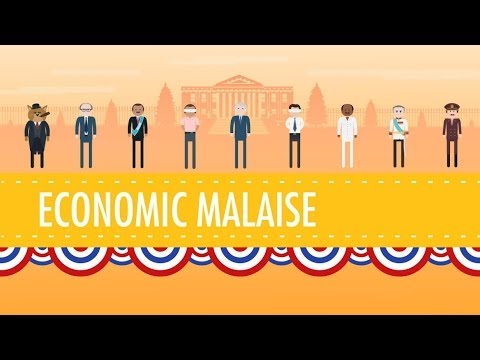
Crash Course: John Green- 'Gerald Ford and Jimmy Carter: The Economic Malaise of the 1970s'

Source:Crash Course- Economic Malaise.
"In which John Green teaches you about the economic malaise that beset the United States in the 1970s. A sort of perfect storm of events, it combined the continuing decline of America's manufacturing base and the oil shocks of 1973 and 1979, and brought about an stagnant economy, paired with high inflation. Economists with a flair for neologisms and portamenteau words called this "stagflation," and it made people miserable. Two presidential administrations were scuttled at least in part by these economic woes; both Gerald Ford and Jimmy Carter are considered failed presidents for many reasons, but largely because of an inability to improve the economy. (hint: In reality, no one person can materially change something as big as the world economy, even if they are president, but one person sure can make a handy scapegoat!) So, by and large, the 70s were a pretty terrible time in America economically, but at least the decade gave us Mr. Green."

From Crash Course

The Great Deflation of the 1970s (as it is more commonly known) really lasted that entire decade with the economy taking a big hit in 1973 thanks to the energy crisis of that year, because of the 1973 Middle East Oil Embargo and it was actually President Richard Nixon who was going, through some really tough political issues that year for well-known reasons. (Anyone old enough to remember Watergate) Who made a big push to move America to energy independence and had almost no success with that. 
But the energy crisis of the early 1970s crisis followed by the 1974-75 recession, followed by a mild recovery of 1976 that had weak economic and job growth. The economy taking a big hit in 1978 with rising interest and inflation rates. Followed by the recession of 1979-80. The American economy was in transition in the 1970s because the Vietnam War was finally ending which is a good thing. 
But the defense budget gets cut in that decade with defense industry losing money as a result. Taxes going up thanks to the Great Society of the 1960s. America becoming more dependent on foreign oil from an unstable area of the world. The Middle East pumping less oil making our energy prices and cost of living with the high interest rates and inflation, very expensive in this country. 

John F. Kennedy Liberal Democrat

John F. Kennedy Liberal Democrat
Source: U.S. Senator John F. Kennedy in 1960